• previous page

EDUCATION

FACT FOCUS

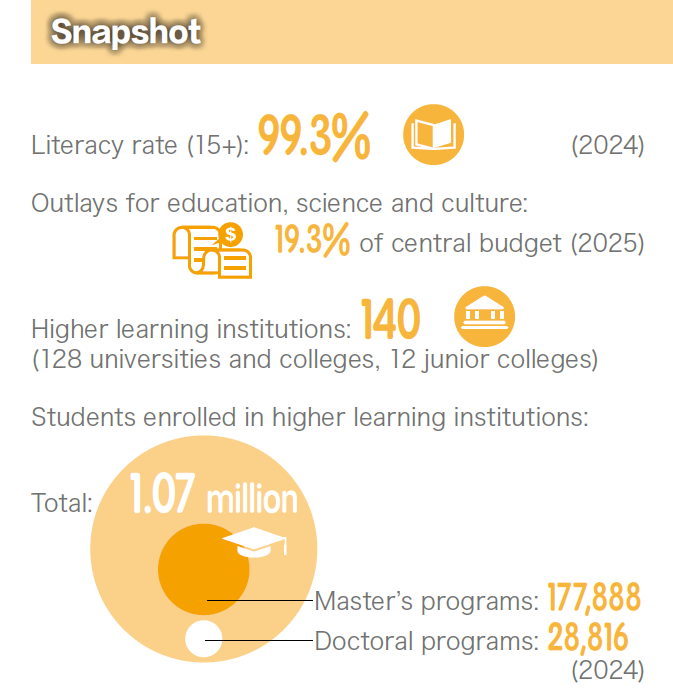
  • There are 140 universities, colleges and junior colleges in Taiwan.
  • The Bilingual 2030 policy promotes English and Mandarin fluency to enhance global competitiveness.
Education is an important component of government policymaking and accounts for a large portion of the national budget. With an increasing emphasis on tertiary education, those with a technical college or university degree account for 50.6 percent of Taiwan’s population, a 7.9 percent increase over the past decade.
The Ministry of Education introduced 12-year basic education in 2014 as an expansion of the existing nineyear compulsory education system. Every year students from Taiwan win distinctions in biology, chemistry, earth sciences, mathematics, informatics and physics in competitions such as the International Science Olympiad.

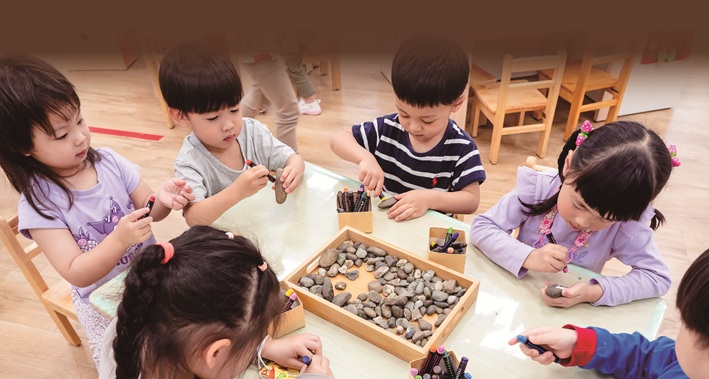
Preschoolers paint pebbles at a government-run day care center as part of an early years curriculum. (Chin Hung-hao)
Preschoolers paint pebbles at a government-run day care center as part of an early years curriculum. (Chin Hung-hao)
 
Taiwan’s educated professionals contribute tremendously to economic prosperity and quality of life.
Recognizing the country’s multicultural nature, the government has included mandatory courses in Taiwan Taigi, Taiwan Hakka, Taiwan Indigenous languages and those of new immigrants in its 12-year basic education curriculum to spur the transmission, revival and development of such languages. To enhance the global competitiveness of Taiwan’s workforce and industry, the government introduced the Bilingual 2030 policy in 2021.
The Ministry of Sports was inaugurated in September 2025 to advance physical education, coordinate sportsrelated activities, encourage citizen involvement and promote the sports industry and sports diplomacy to forge a healthy society.
Scholarship Programs
Both government and university scholarships are available for international students. The Taiwan Scholarship program offers funding to students who wish to pursue undergraduate or graduate degrees in diverse fields. Applicants can contact embassies and representative offices or visit the MOE’s website:https://english.moe.gov.tw/lp-24-1.html.
The MOE has also established the Huayu Enrichment Scholarship to encourage international students to learn Mandarin in Taiwan and expand their knowledge of Taiwan’s culture and society. This program enables foreign students to take Mandarin courses at 65 university-affiliated language learning centers around the country. A list of Mandarin training centers and other information on learning the language in Taiwan can be found on the websites of the MOE, Study in Taiwan (www.studyintaiwan.org) and the Taiwan Mandarin Educational Resources Center (https://lmit.edu.tw/en/school_list).
Literacy rate (15+): 99.3% (2024)
 
Yehliu Queen s Head